The Quiet Employee Problem
Silence in a huddle is not agreement. Many quiet employees are watching closely. They just will not compete for airtime to say what they see.
Who actually sees the work
On most teams, a few people run the conversation in meetings, stand-ups, and calls. Everyone else nods, takes notes, or talks after the session ends. Meanwhile, the people closest to the work often stay quiet: the nurse who sees the same handoff fail at shift change, the warehouse associate who knows which label causes rework, the account lead who will not interrupt the exec on a client call, the line cook who rarely speaks but knows prep is backwards, the field tech who skips the social lunch but can tell you which supervisor actually enforces standards.
Those observers are not necessarily disengaged. They are often grounded in day-to-day reality. They simply do not speak up in public, and organizations mistake quiet for "no issues." Morrison and Milliken's work on organizational silence describes how withheld concerns accumulate when speaking up feels risky (Morrison & Milliken, 2000).
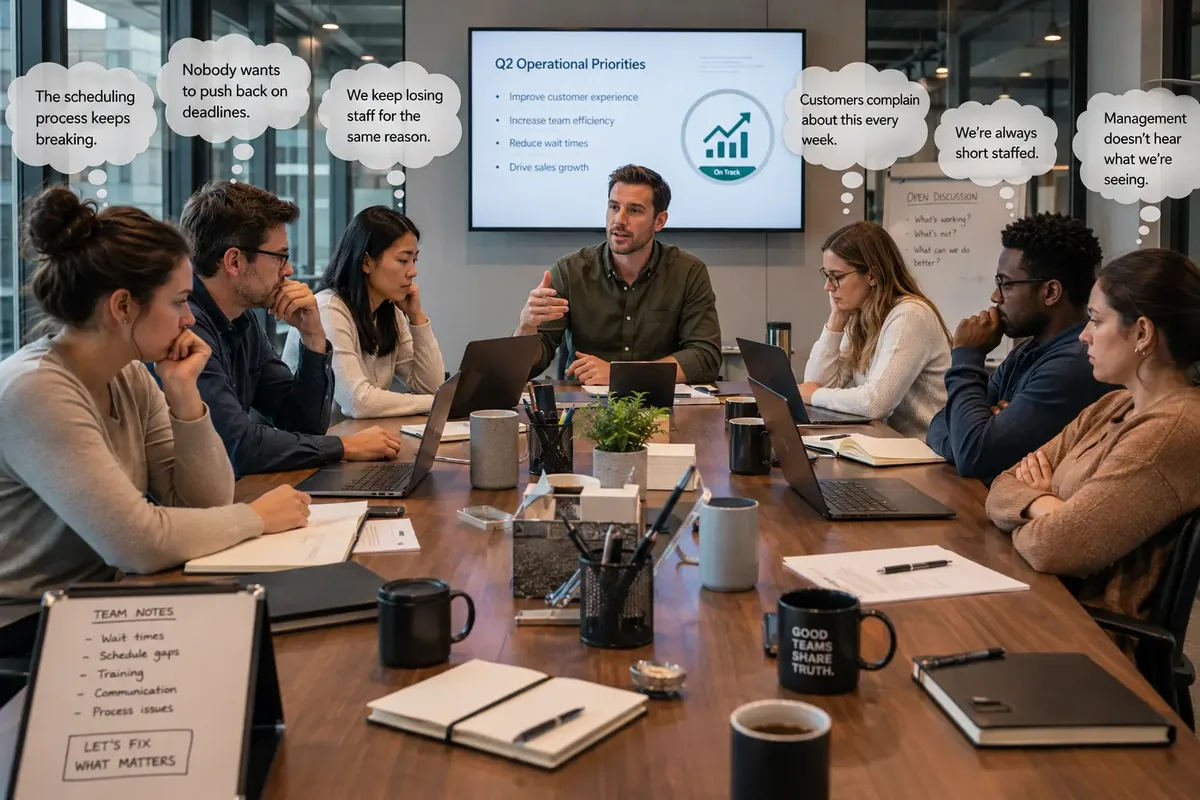
Quiet is not the same as disengaged, or only introverted
Introversion is about energy and communication style, not commitment. Many introverted employees prefer written, one-to-one, or asynchronous input over open-floor brainstorms. When the only sanctioned feedback moment is a group round-robin, you under-sample their insight.
But quiet signal also comes from people who are engaged and careful, not shy:
- Junior or new hires who do not yet feel safe challenging the room.
- Contractors and gig workers who see process failures but do not "own" the fix.
- Non-native speakers or staff from cultures where public dissent reads as disrespect.
- Remote contributors who stay muted while issues pile up in side channels.
- Anyone with something to lose, probation, visa sponsorship, a prior bad experience speaking up.
When the only sanctioned feedback moment is public and synchronous, you systematically under-sample the people who see the most. That is a sampling problem, not a personality flaw. Leadership still needs their view of the operation.
Where the signal hides
The pattern repeats across industries; only the details change:
- Healthcare: Bedside staff notice workflow gaps long before leadership sees a metric move.
- Retail and hospitality: Frontline teams watch the same equipment, rush, or scheduling failure every week.
- Logistics and manufacturing: Shift workers know which step actually causes defects or delays.
- Professional services: Delivery teams see client risk but will not contradict the partner in the room.
- Technology and remote teams: Sharp observers stay silent in retro while the real diagnosis lives in DMs.
- Field, trades, and construction: Crews know the workaround on site that never makes it to the office.
In every case, the best observers are often the least likely to compete for airtime.
Why public forums discourage honesty
Meetings, stand-ups, huddles, and video calls add status, timing, audience, and fear of derailing the agenda. People edit in real time, especially when a manager or owner is watching. Response-bias research finds that answers often drift toward what feels acceptable to the person asking (Bradburn, Sudman, & Wansink, 2004). Live group settings follow the same logic.
- Spotlight cost: Speaking up means everyone looks at you.
- Interruption culture: Fast talkers dominate; careful thinkers get cut off.
- Retrospective risk: A comment in all-hands can be remembered long after the issue is fixed.
- False consensus: Nods look like agreement; silence looks like buy-in.
- Performative check-ins: Stand-ups and huddles stay time-boxed; "everything fine?" becomes ritual, not inquiry.
- Remote friction: Dominant speakers and mute buttons make it easy to stay invisible on camera.
Detert and Edmondson report that employees withhold improvement-oriented ideas when they expect indifference or negative consequences (Detert & Edmondson, 2011). Quieter employees often feel that risk first.
Operational blind spots when only loud voices count
When feedback channels are mostly verbal and public, leaders learn from a biased slice of the team:
What the room heard: "Team morale is good. No major blockers."
What quiet observers knew: the handoff breaks every Friday, the same person gets favorable shifts, the tool workaround burns two hours a week, and three people are job searching.
- Recurring process failures stay invisible until a client, patient, or customer complains.
- Manager issues get discussed privately, not in the conference room.
- Meetings sound fine while burnout builds on the frontline.
- Loud high performers get mistaken for the whole team's mood.
You are not hearing the whole team. You are hearing whoever is willing to sound engaged in front of others.
Creating safer communication channels
Edmondson defines psychological safety in teams as a shared belief that interpersonal risk-taking is acceptable (Edmondson, 1999). That is built through behavior over time. While you are building it, add channels that do not require speaking up in public:
- Private written input: Short forms, links, or QR codes, not only open mics.
- Anonymous aggregation: Themes without singling out the quiet person who finally wrote in.
- Async windows: Let people respond after they have had time to think.
- Skip-level routes: Some issues land better with HR or a lead who is not the daily manager.
The goal is not to eliminate meetings. It is to stop treating a meeting as the only place truth counts.
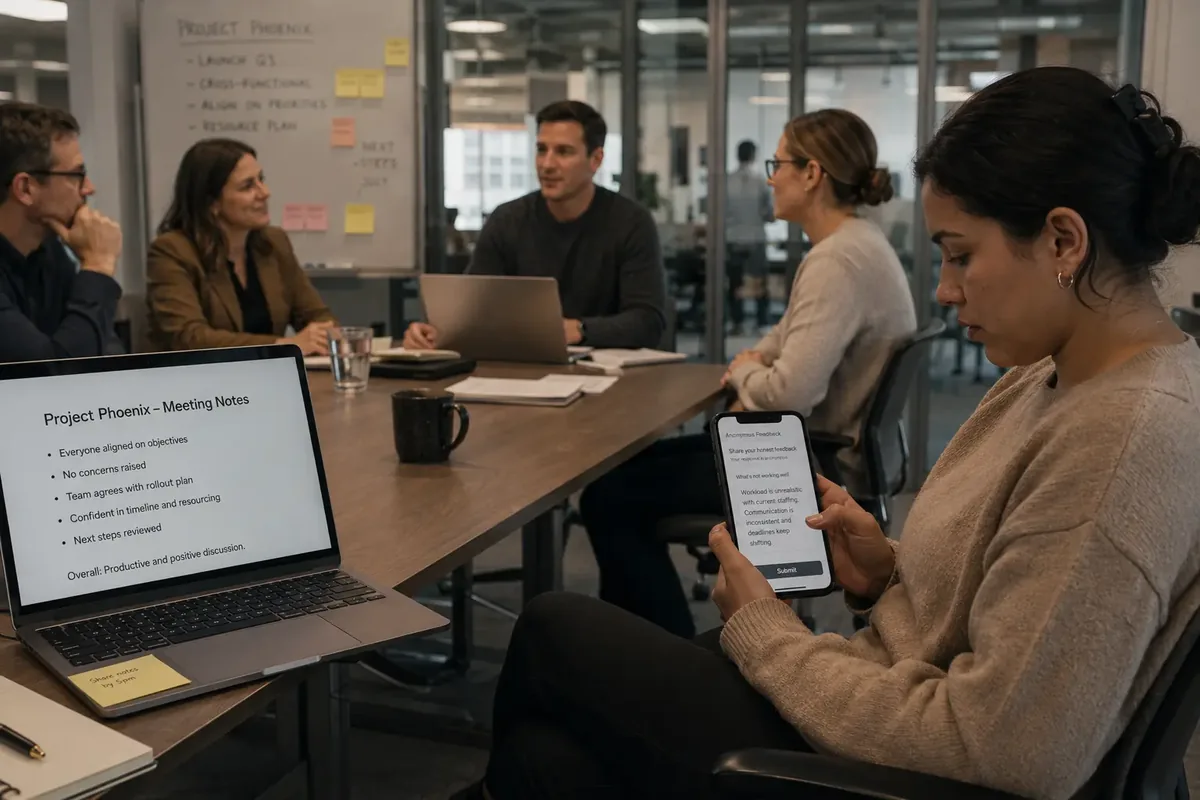
Designing for quiet signal, not louder meetings
Practical habits:
- Share back themes from private channels without quoting individuals, for example, handoffs, closing-to-opening gaps, labeling errors, or scope creep mentioned again.
- Invite written prep before big discussions so thoughtful people arrive with substance.
- Reward operational fixes, not only who talks most in the room.
- Notice who rarely speaks publicly but consistently executes. They may see problems early.
Related: Feedback Your Team Is Afraid to Give and Most Workplace Problems Start Small.
How MaskedReviews fits
MaskedReviews lets quiet employees submit short private feedback without speaking in public or attaching their name to each line. Responses roll into daily digests and recurring themes on your dashboard, so leadership sees patterns from observers who would not compete for airtime, while you keep building safer direct conversation over time.
References
- Morrison, E. W., & Milliken, F. I. (2000). Organizational silence: A barrier to change and development in a pluralistic world. Academy of Management Review, 25(4), 706–725. doi.org/10.2307/259200
- Bradburn, N., Sudman, S., & Wansink, B. (2004). Asking Questions (2nd ed.). Jossey-Bass. Open Library
- Detert, J. R., & Edmondson, A. C. (2011). Implicit voice theories: Taken-for-granted rules of self-censorship at work. Academy of Management Journal, 54(3), 461–488. doi.org/10.5465/amj.2011.61967925
- Edmondson, A. (1999). Psychological safety and learning behavior in work teams. Administrative Science Quarterly, 44(2), 350–383. doi.org/10.2307/2666999
Join Early Founder ($5 for 90 days)
Hear from observers who rarely speak in public forums—not just all-hands. Private capture and rollups surface their operational signal.
Early Founder: $5 for 90 days, then $10/mo locked for life. Standard pricing will be $19.99/mo.