
Most Workplace Problems Start Small
No one quits because of one broken shift. They quit after the hundredth small annoyance that leadership never quite heard.
Death by a hundred small annoyances
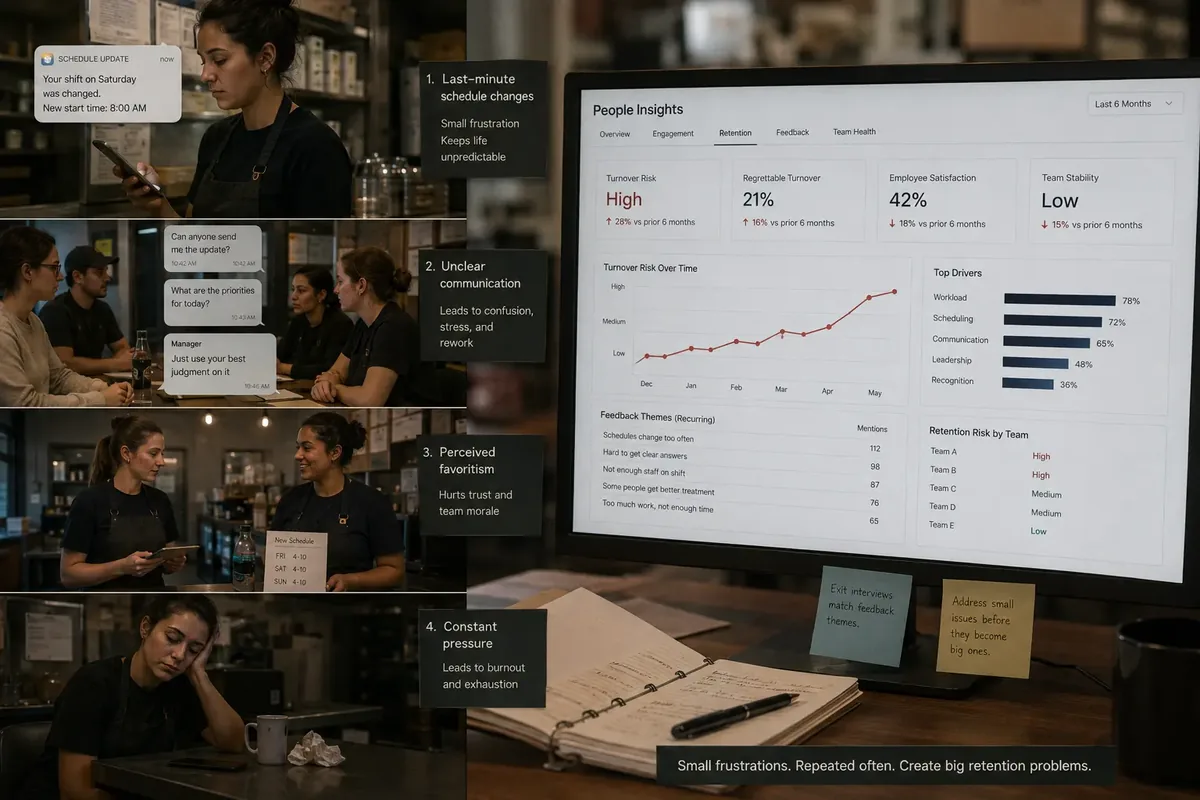
Workplace breakdowns are often described as sudden: a blow-up, a resignation letter, a public complaint. Behind that moment is usually a long stretch of minor friction: schedule changes without notice, vague priorities, perceived favoritism, tools that never get fixed, praise that always lands on the same names.
Each issue alone can feel too small to escalate. Together they tell people the organization rarely adjusts when work gets harder. Hirschman described how members respond to problems through voice or exit (Hirschman, 1970). Detert and Edmondson show how voice gets withheld when people expect speaking up will not help (Detert & Edmondson, 2011).
Scheduling frustrations that teach helplessness
One unfair weekend rotation is annoying. A season of last-minute changes teaches people their time is not respected. Staff stop asking because the answer is always "we're slammed." The business loses predictability, then loses people who needed recovery between closes and opens.
Scheduling complaints are early warnings. They often show up before HR sees quits rise.
Communication issues that look like attitude problems
When priorities change in a group chat but never reach the floor, frontline workers look disengaged. They are not confused about caring. They are tired of guessing. Small communication gaps create rework, guest-facing mistakes, and private frustration that managers read as bad culture instead of bad information flow.
Favoritism perceptions, even when unintended
People track fairness: who gets desirable shifts, who gets coached versus written up, whose mistakes get dismissed. A few perceived slights may not destroy trust. Repeated slights without explanation can, especially when raising them feels like a personal attack. Morrison and Milliken link sustained silence to problems that never reach formal channels (Morrison & Milliken, 2000).
Leaders often hear about favoritism narratives late, in exit interviews, because no one wanted to be the accuser earlier.
Burnout signals before someone breaks
- More call-outs and shift trades on the same team
- Jokes about surviving the week that stop being funny
- Quality slips guests notice before dashboards do
- Fewer volunteers for extra projects
These are symptoms of accumulated load: understaffing, broken handoffs, managers who only react when something is already on fire.
Why major-incident-only feedback misses the pattern
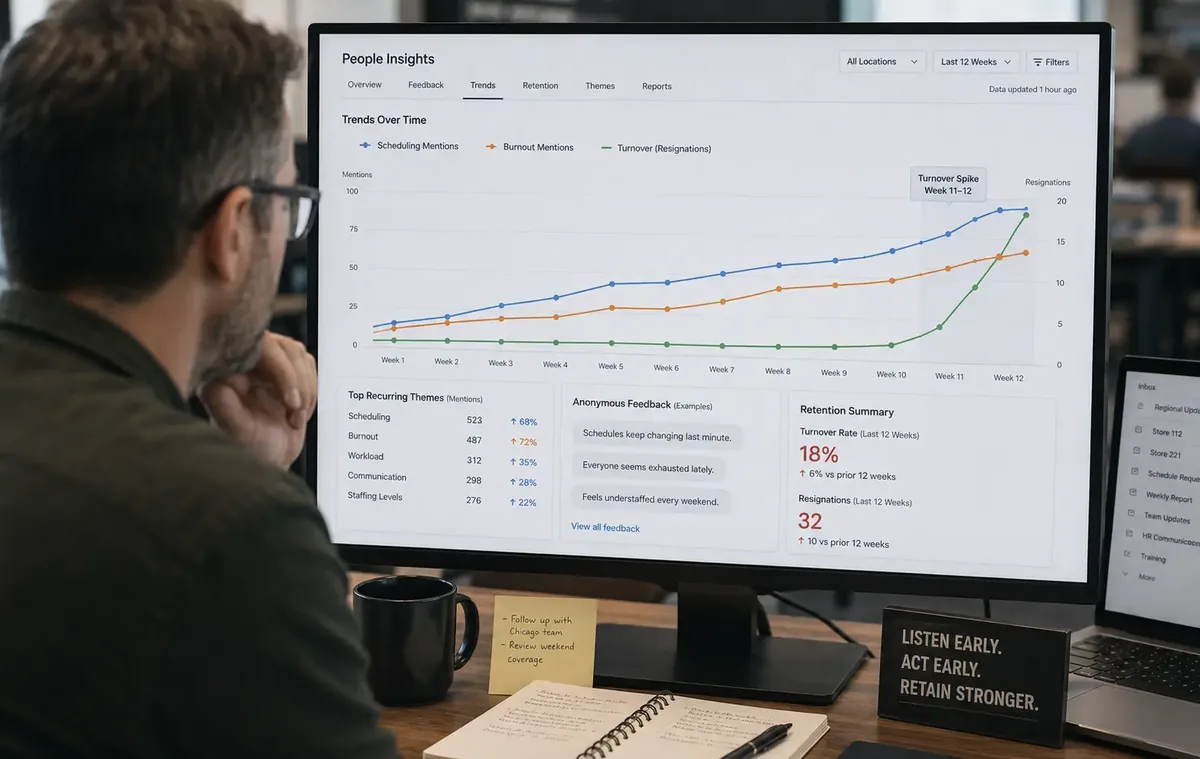
Hotlines and "tell HR if something serious happens" channels catch escalations, not slow drift. Anonymous feedback is most useful when it is routine: short submissions about everyday friction, rolled up so operators see themes repeat across weeks.
That is how you move from "we had no idea" to "scheduling has come up eleven times this month. Let's change the rule."
Acting on patterns, not panic buttons
Early response habits:
- Treat recurring themes as operational work, not personality complaints.
- Share what you changed when a theme drops, not only when someone threatens to leave.
- Protect anonymity so small issues get reported before they escalate.
- Review turnover numbers and qualitative themes in the same meeting.
Edmondson's work suggests teams learn faster when people believe speaking up is safe (Edmondson, 1999). Small fixes that follow small reports help build that belief.
How MaskedReviews fits
MaskedReviews is built for ongoing signal, not only crises: employees submit private feedback without an account, and your dashboard rolls responses into daily digests and recurring themes. You see scheduling, communication, fairness, and burnout patterns while they are still small, when fixes cost less than replacing a trained team.
References
- Hirschman, A. O. (1970). Exit, Voice, and Loyalty: Responses to Decline in Firms, Organizations, and States. Harvard University Press. Harvard University Press
- Detert, J. R., & Edmondson, A. C. (2011). Implicit voice theories: Taken-for-granted rules of self-censorship at work. Academy of Management Journal, 54(3), 461–488. doi.org/10.5465/amj.2011.61967925
- Morrison, E. W., & Milliken, F. I. (2000). Organizational silence: A barrier to change and development in a pluralistic world. Academy of Management Review, 25(4), 706–725. doi.org/10.2307/259200
- Edmondson, A. (1999). Psychological safety and learning behavior in work teams. Administrative Science Quarterly, 44(2), 350–383. doi.org/10.2307/2666999
Join Early Founder ($5 for 90 days)
Catch recurring small frustrations in private rollups before they compound into turnover and culture damage.
Early Founder: $5 for 90 days, then $10/mo locked for life. Standard pricing will be $19.99/mo.