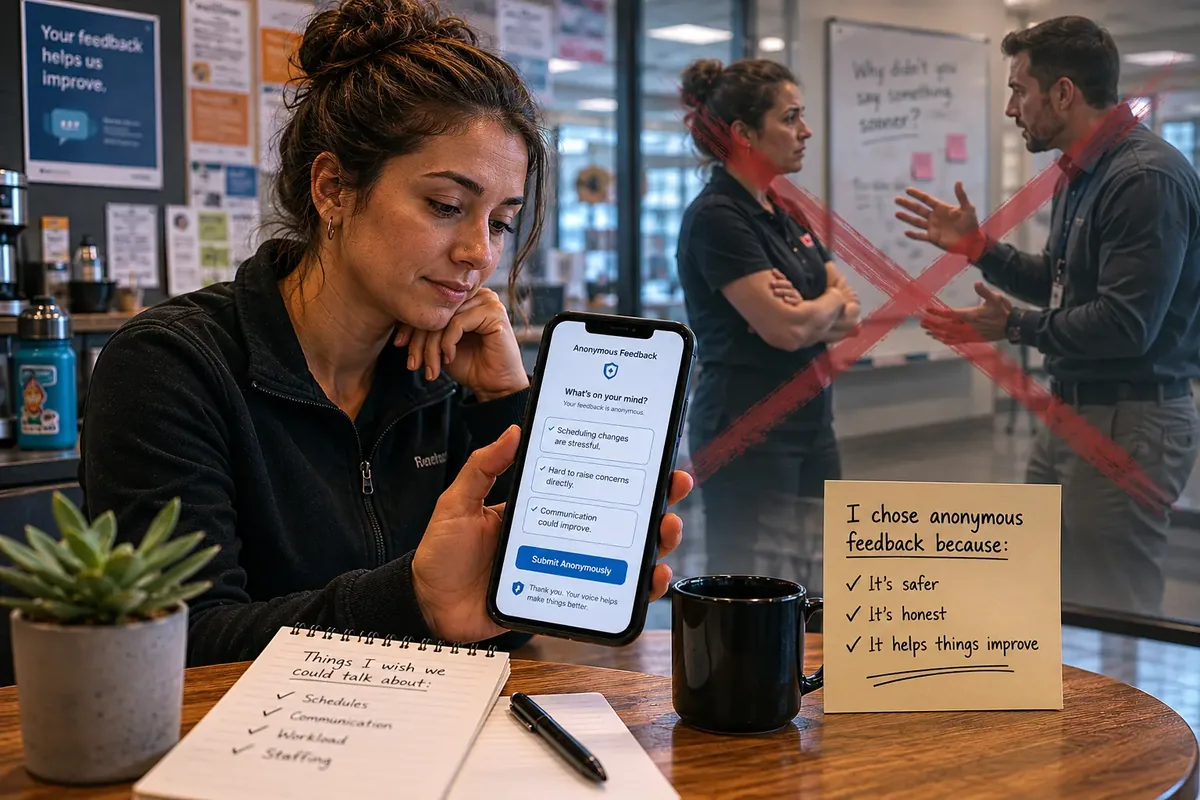
Employees
Internal voice, without the fear
Culture, safety, scheduling, and management concerns, shared through internal links. They roll up into themes your people team can act on.
People open up when they trust it's anonymous
MaskedReviews sits between your organization and the people giving feedback: customers after a visit or purchase, and employees who need to speak up without fear of being identified. Responses roll up into daily insights and a rolling 7-day summary with clear action items, so your team can fix what matters without chasing individual identities.
No account needed. Your response stays private.
Honest feedback from the people who know your business best. You see themes, not names.
Employees
Culture, safety, scheduling, and management concerns, shared through internal links. They roll up into themes your people team can act on.
Customers
Post-purchase and in-store feedback on receipts, emails, and QR codes. Daily insights before issues show up in public reviews.
Your feedback is anonymous, private, and used to help businesses improve, not to identify individuals.
Share your honest experience. No sign-up or personal information required.
We remove any identifying details. Your feedback is secure and separated from your identity.
Our system analyzes feedback to find trends and recurring themes. No individual feedback is shown.
Businesses receive summarized insights to understand what matters most and make meaningful improvements.
Honest feedback. Private always. Better businesses for everyone.
Who it's for
MaskedReviews works for customer-facing teams and people leaders who need the truth without chasing names.
Submitters use a simple form. No account required. Their identity is not shown to your company by default, so you hear what actually happened, not what feels safe to say.
Feedback flows through MaskedReviews, not your HR inbox or a manager's spreadsheet, so employees and customers know you're not holding the identity switch. Collect staff reviews and internal feedback without the usual "they'll know it was me" risk.
Same dashboard, two time horizons. Catch today's spike and recurring themes across the last seven days without overreacting to one message.
Similar phrases stack into priorities you can act on: what to fix first, what to watch, and what's already working.
Print a short link or QR at the bottom of every receipt, plus tables, packaging, and email footers. The public form runs on a separate origin from your company dashboard.
Customers on receipts. Employees on internal links. One place for aggregated insight, with no names on your desk.
Honest signal
Operations
"Public reviews reward the loudest voices. Private feedback gives us more responses and a clearer read on what's working and what needs attention."
Employee voice
People team
"Internal surveys feel like HR is watching. When feedback goes through a neutral third party and we only see themes, people actually flag what's broken."
Separate sites
Store ops
"The feedback form and our company dashboard live on different sites. Submitters never land in our console, but we still get structured responses we can track over time."
One platform for customers and staff: QR codes and short links on receipts, counters, and internal channels. No app install. No login wall.
Where your MaskedReviews link goes
Print a QR or short link at the bottom of every receipt, right after payment, while the experience is still fresh.
Add to order confirmations and shipping updates, right after the details customers care about.
Use the same line at the bottom of support replies, follow-ups, and other routine correspondence.
Email staff from People/HR or internal comms with a standing link they can use whenever feedback comes up.
Table tents, counter cards, and window stickers. Download the QR from your dashboard and print anywhere customers pause.
Resources
Articles on anonymity, psychological safety, reviews, and operational improvement for operators who want better signal, not more noise.
Why guests and buyers stay quiet in person, how silent churn shows up, and how private channels complement public reviews.
Most customers avoid confrontation. Instead of sharing negative feedback directly, they quietly stop coming back. Learn why traditional feedback fails and how anonymous channels surface more honest insights.
An angry customer at least gives you a chance to fix the problem. Silent customers simply disappear. Focus on honest private feedback before customers churn.
Public reviews are often emotional extremes. Everyday operational frustrations rarely go online. Anonymous feedback helps businesses hear the middle ground.
Does anonymity make people more honest? Research says it helps on sensitive topics, criticism, and social pressure. Here is what the studies show, and where anonymity falls short.
Businesses often ask for feedback at the worst moment, with too much friction. Common mistakes and lighter alternatives.
Public reviews influence reputation. Anonymous feedback improves operations. Most businesses need both, for different reasons.
It's rarely dramatic issues that hurt most. Slow service, poor communication, confusing processes, and inconsistency quietly damage trust over time.
Ignoring feedback compounds into lost retention, weaker reputation, and operational blind spots. Explore the real business cost of not listening.
What your team sees before turnover spikes—manager friction, scheduling, and operations issues leadership often learns about too late.
Many workplace issues never get reported because employees fear awkwardness, conflict, or retaliation. Anonymous feedback can uncover operational issues before they become culture problems.
When people feel safe speaking honestly, businesses learn faster. Psychological safety impacts customer experience, employee retention, and operational improvement.
Most operational problems are already known internally long before management notices. Anonymous employee feedback surfaces recurring themes like scheduling, managers, and workload without putting individuals on the spot.
By the time someone quits, trust is often already gone. Exit interviews tend to produce polite, filtered answers, not the operational truth leadership needs to fix turnover.
Most employees soften criticism in direct conversations with a manager or owner, especially in small businesses where relationships are personal. That is social risk management, not dishonesty.
The staff most likely to notice operational problems are often the least likely to speak in meetings. Without quieter channels, businesses hear the loudest voices, not the sharpest observations.
Retention and culture crises rarely appear overnight. They grow from recurring small frustrations that people do not feel safe raising, until anonymous patterns make the drift visible early.
Anonymity is not an invitation to attack. It lowers social pressure so employees can be honest about operations without managing consequences in the room.
Early access
Sign up in minutes. You get a shareable anonymous link, honest feedback from customers and your team, daily digests, and a rolling 7-day summary on your dashboard. Fair-use limits may apply as we grow.
Multiple brands or regions? hello@maskedreviews.com