
Anonymous Feedback Isn't About Hiding. It's About Removing Pressure.
People do not want a secret life. They want a way to tell the truth without turning every issue into a personal confrontation.
What anonymity is actually for
Leaders sometimes hear "anonymous feedback" and picture venting or people who refuse to speak directly. In most workplaces, especially small ones, the barrier is usually social pressure: who is listening, what happens tomorrow, whether you will be labeled difficult.
Anonymous channels change the audience, not accountability. Tourangeau and Smith reviewed how privacy and survey mode affect willingness to answer sensitive questions (Tourangeau & Smith, 1996). Workplace tools apply the same idea: make reporting feel lower risk so honesty is about the issue, not the relationship moment.
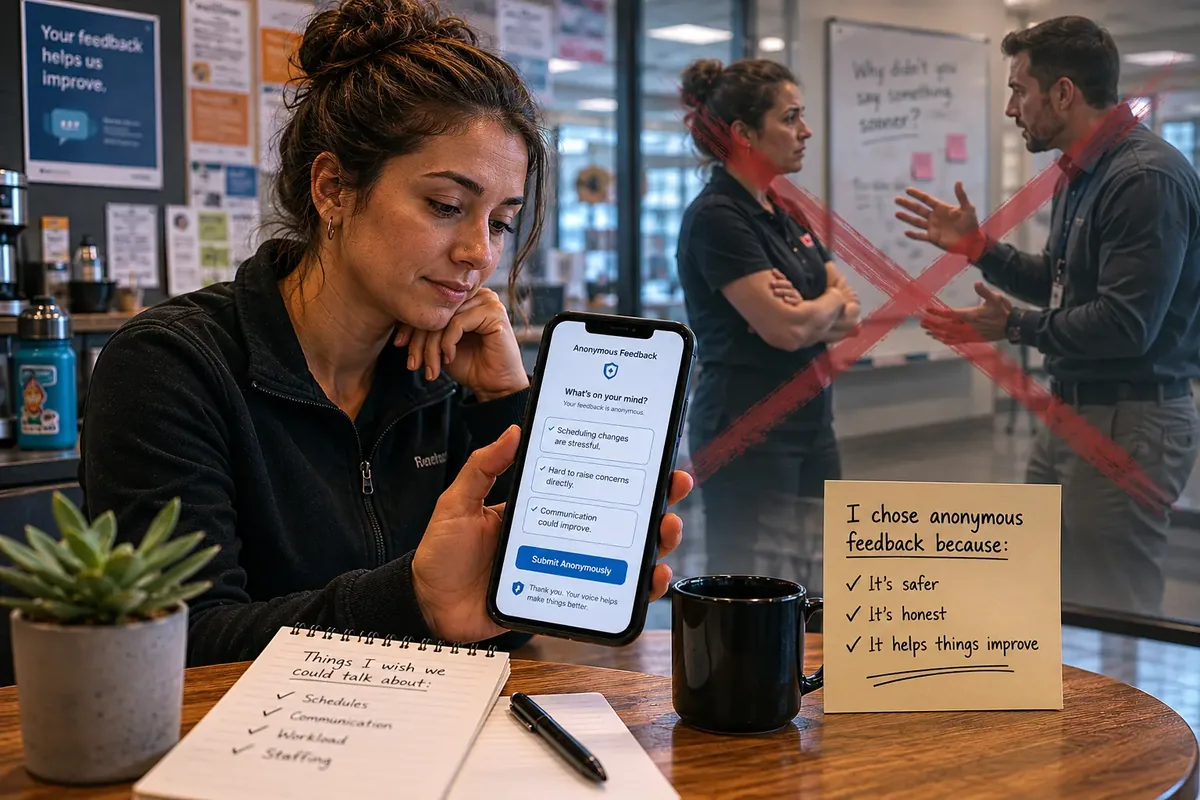
Reducing awkwardness without avoiding hard topics
Employees soften criticism when a manager is nearby, when a peer might repeat the comment, or when the only moment to speak is a group round-robin. Lowering pressure does not remove the topic. It removes the performance around the topic.
That is why private, short capture often surfaces specifics (for example, close-to-open scheduling broke again) that polite meetings only gesture at (we are stretched).
Constructive criticism vs. attacks
Healthy anonymous programs steer toward operational improvement:
- Broken handoffs, not personal attacks
- Recurring schedule rules, not break-room gossip
- Training gaps, not rumors about coworkers
When leadership aggregates themes and acts on systems, submissions stay constructive. When leaders hunt authors or punish vague complaints, the channel goes quiet. Detert and Edmondson document similar withdrawal when people expect speaking up will backfire (Detert & Edmondson, 2011).
Anonymity does not create negativity. It can surface what social pressure was already suppressing.
Honesty without confrontation
Clear standards, coaching, and accountability still matter. Not every operational insight needs a tense one-on-one messenger. Many people tolerate a broken process for months rather than trigger conflict with a manager they still work beside.
Anonymous feedback separates operational signal from the relationship conversation. Owners can still fix the schedule, retrain the handoff, or review manager conduct without making every pattern a question of who said it.
Operational improvement over blame
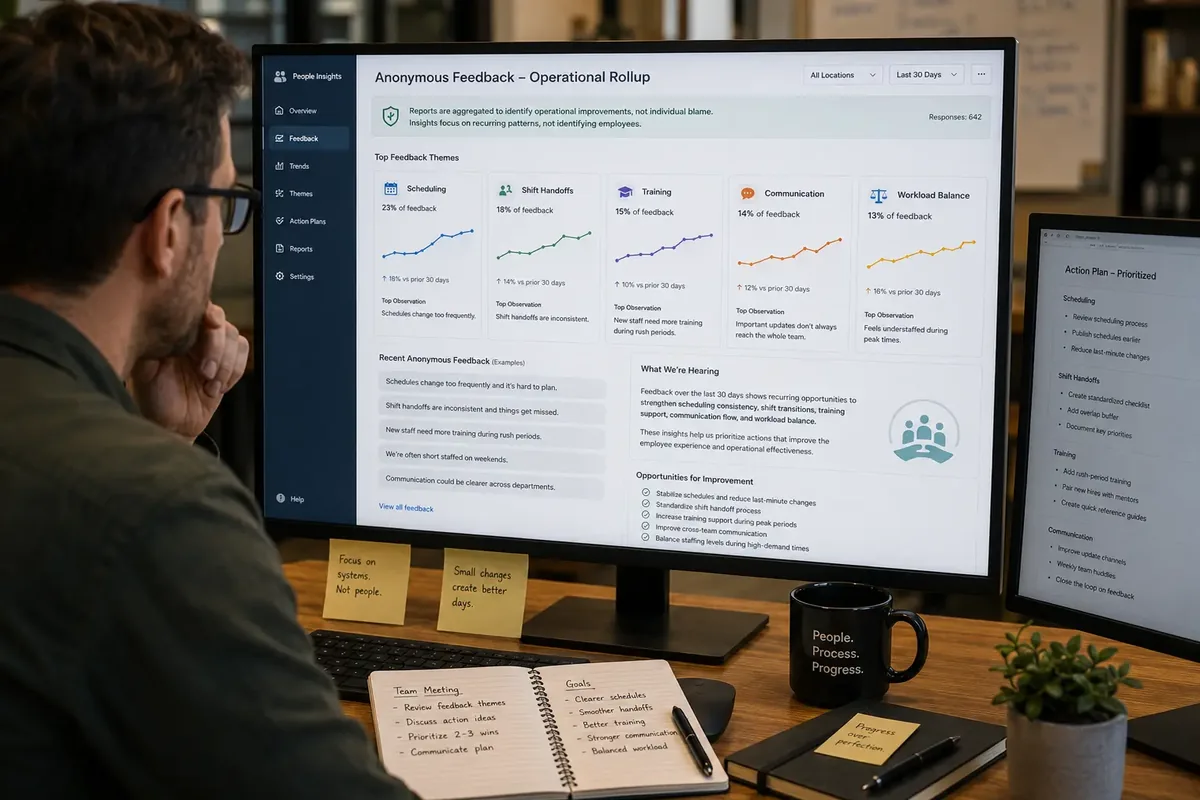
The best use of private employee input looks like operations, not a blame game:
- Count themes; do not rank individuals from one line.
- Share actions: we changed the close-to-open rule after repeated mentions.
- Pair anonymous rollups with fair manager coaching when conduct themes repeat.
- If submissions drop after a visible fix, that may mean the channel is working.
Edmondson's research on psychological safety in teams describes the long-term goal: shared belief that speaking up is acceptable (Edmondson, 1999). Anonymity can help while that belief is still developing.
Push back on the "just talk to me" myth
Open doors help. They are not always enough when hierarchy, history, and small-team relationships make honesty costly. Saying "I have an open door" does not undo a past dismissal or awkward reaction.
Removing pressure is not hiding. It is designing a channel where employees can describe what is broken without calculating what will happen to them for saying it.
How MaskedReviews fits
MaskedReviews sits between your organization and the person giving feedback: short private submissions, no account required for respondents, and rollups that highlight recurring operational themes without attaching names to each response. Leaders hear pressure-free input aimed at fixes; employees keep day-to-day relationships intact while the business sees what meetings often miss.
References
- Tourangeau, R., & Smith, T. W. (1996). Asking sensitive questions: The impact of data collection mode, question format, and question context. Public Opinion Quarterly, 60(2), 275–304. doi.org/10.1086/297751
- Detert, J. R., & Edmondson, A. C. (2011). Implicit voice theories: Taken-for-granted rules of self-censorship at work. Academy of Management Journal, 54(3), 461–488. doi.org/10.5465/amj.2011.61967925
- Edmondson, A. (1999). Psychological safety and learning behavior in work teams. Administrative Science Quarterly, 44(2), 350–383. doi.org/10.2307/2666999
Join Early Founder ($5 for 90 days)
Lower social pressure on employees so honesty shows up as operational themes, not hallway confrontations.
Early Founder: $5 for 90 days, then $10/mo locked for life. Standard pricing will be $19.99/mo.