
What Customers Actually Want Businesses To Improve
Big failures get attention. Small recurring frictions decide whether people come back.
Common recurring themes
Service quality research has long pointed to reliability, responsiveness, and communication as core drivers of satisfaction (Parasuraman, Zeithaml, & Berry, 1985). Across restaurants, retail, and services, anonymous comment clusters often repeat the same practical themes:
- Wait times and staffing mismatch
- Communication, hours, policies, order status
- Cleanliness and maintenance details
- Billing surprises and refund friction
- Inconsistent experiences between locations or shifts
Operational friction vs catastrophic failures
A food safety crisis is rare but severe. A confusing loyalty program is common and corrosive. Teams over-index on catastrophes because they are visible; customers leave because of daily rough edges.
AI summarization and pattern detection
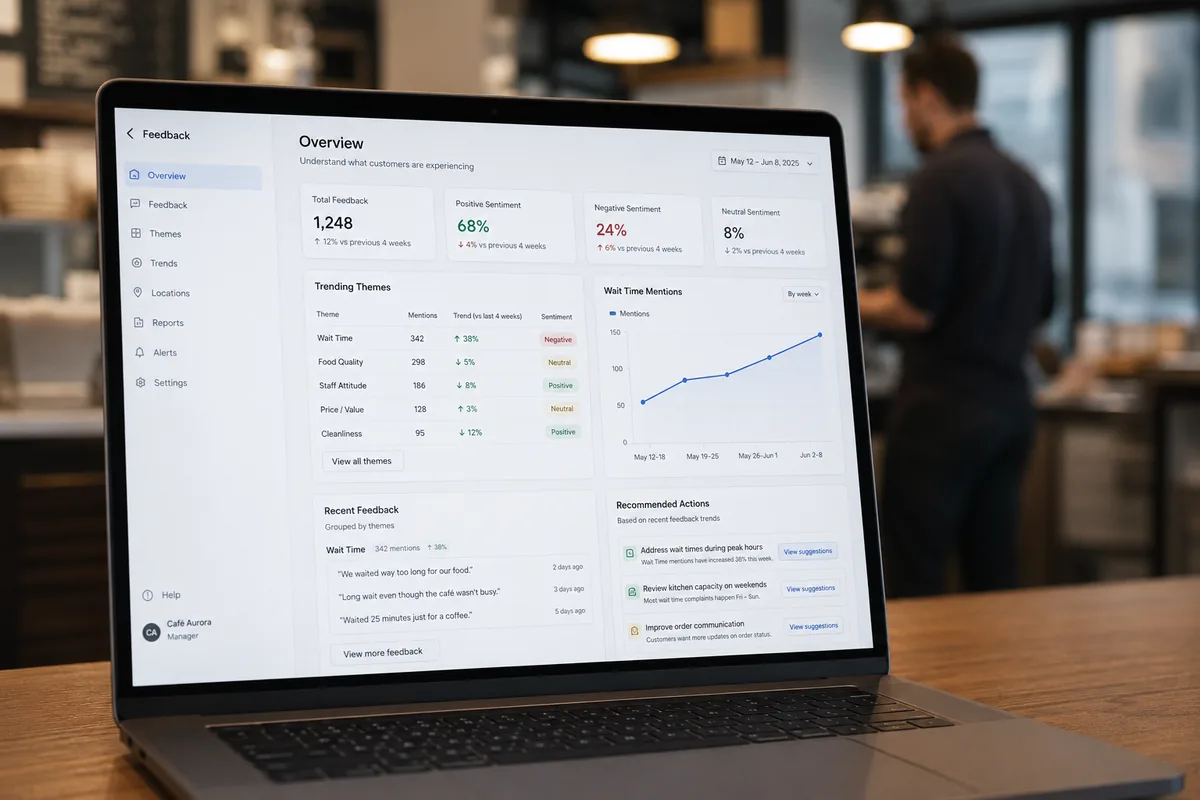
When volume grows, manual reading fails. Summarization, human or assisted, groups phrases into themes with counts and exemplar quotes. Leaders debate priorities with evidence: "Parking" mentioned 40 times in March, not once in a hallway anecdote.
Why businesses miss small complaints
Small issues do not trigger escalation workflows. No one files a ticket for "music too loud." Anonymous aggregation makes the small stuff visible at scale.
Daily and rolling 7-day prioritization
Daily digests catch acute spikes (event night staffing). The rolling 7-day summary shows whether a theme is recurring. Alternating focus prevents both firefighting-only and strategy-only blindness.
How MaskedReviews fits
MaskedReviews rolls responses into daily digests and a rolling 7-day summary with suggested actions, built to elevate recurring operational themes, not only the loudest single comment.
References
- Parasuraman, A., Zeithaml, V. A., & Berry, L. L. (1985). A conceptual model of service quality and its implications for future research. Journal of Marketing, 49(4), 41–50. doi.org/10.1177/002224298504900403
- Bradburn, N., Sudman, S., & Wansink, B. (2004). Asking Questions (2nd ed.). Jossey-Bass. Open Library
Join Early Founder ($5 for 90 days)
Recurring themes surface in daily and rolling 7-day rollups instead of getting lost in one-off anecdotes.
Early Founder: $5 for 90 days, then $10/mo locked for life. Standard pricing will be $19.99/mo.