
Silent Customers Are More Dangerous Than Angry Ones
Complaints are uncomfortable; silence is expensive. The customers who never write or speak are often the majority.
Customer churn behavior
Churn is not always dramatic. Many customers fade out: one fewer visit per month, switching brands quietly, or not renewing without telling you why. Classic research on dissatisfaction finds that many unhappy customers choose exit or negative word of mouth instead of complaining to the business directly (Singh, 1990; Hirschman, 1970).
Why unhappy customers rarely complain directly
Complaining takes effort and emotion. People must believe the business cares, that fixing the issue is worth their time, and that they will not be judged. If any of those fail, exit beats voice (Hirschman, 1970).
Angry customers, by contrast, still engage. They want acknowledgment, even if the review is harsh. That engagement is a recovery opportunity.

Public reviews vs. private feedback
Public reviews are a small, skewed sample. They favor memorable highs and lows. The guest who had a mediocre meal, okay food, slow bar service, confusing bill, often posts nothing. That experience still shapes whether they return.
Private anonymous feedback captures the middle: operational friction that never becomes a star rating but still erodes trust.
Lowering the barrier to honesty
QR codes on receipts, table tents, and follow-up links work when they are fast and clearly private. No login, no public profile, no "name your server so we can praise them" requirement. Lower friction increases volume; anonymity increases candor on sensitive details (Tourangeau & Smith, 1996).
AI summaries and recurring pain points
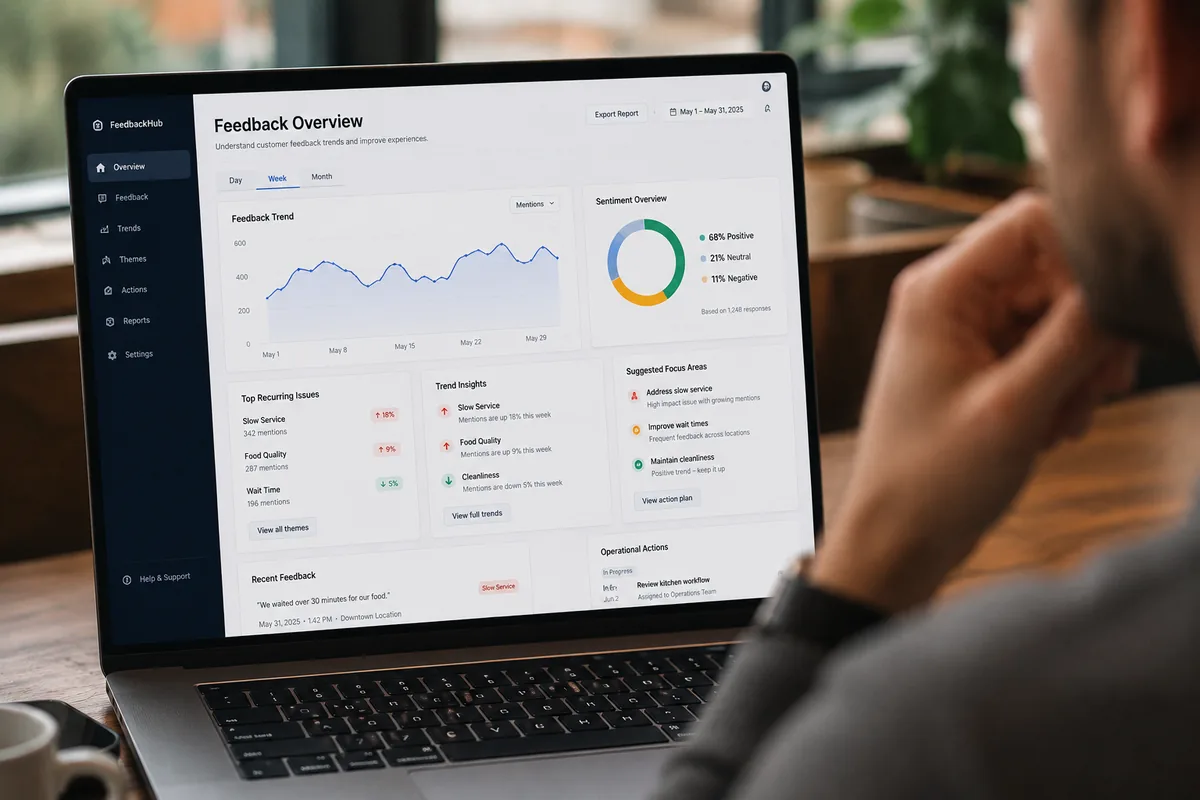
Raw comments become useful when rolled up. Daily digests and a rolling 7-day summary can cluster themes, wait times, communication gaps, cleanliness, so managers prioritize fixes instead of reading hundreds of lines individually. The goal is pattern detection before silent churn shows up in revenue.
How MaskedReviews fits
MaskedReviews combines lightweight capture with daily digests and a rolling 7-day summary in your dashboard. You hear from customers who would never leave a public review, and you see whether the same issue is spreading before it becomes a steady drop in repeat visits.
References
- Hirschman, A. O. (1970). Exit, Voice, and Loyalty: Responses to Decline in Firms, Organizations, and States. Harvard University Press. Harvard University Press
- Singh, J. (1990). Voice, exit, and negative word-of-mouth behaviors: An investigation across three service industries. Journal of the Academy of Marketing Science, 18(1), 1–15. doi.org/10.1177/009207039001800101
- Tourangeau, R., & Smith, T. W. (1996). Asking sensitive questions: The impact of data collection mode, question format, and question context. Public Opinion Quarterly, 60(2), 275–304. doi.org/10.1086/297751
Join Early Founder ($5 for 90 days)
Catch quiet dissatisfaction in private comments before it shows up as missing repeat visits.
Early Founder: $5 for 90 days, then $10/mo locked for life. Standard pricing will be $19.99/mo.