
The Problem With Asking Employees For Honest Feedback Face-To-Face
A sincere "How are things going?" often gets a sincere but incomplete answer. People protect relationships before they volunteer uncomfortable truth.
Social pressure in small teams
In a ten-person shop, the owner might also be the scheduler, the conflict resolver, and the person who writes references. Every one-on-one carries relationship weight. Employees notice tone, past reactions, and who is close to whom. Even when a manager wants honesty, the setting is social, and social settings reward harmony.
Bradburn, Sudman, and Wansink summarize decades of survey research on response bias, including tendencies to give answers that feel acceptable to the person asking (Bradburn, Sudman, & Wansink, 2004). The same pressure appears in live conversations, especially when work and personal rapport overlap.
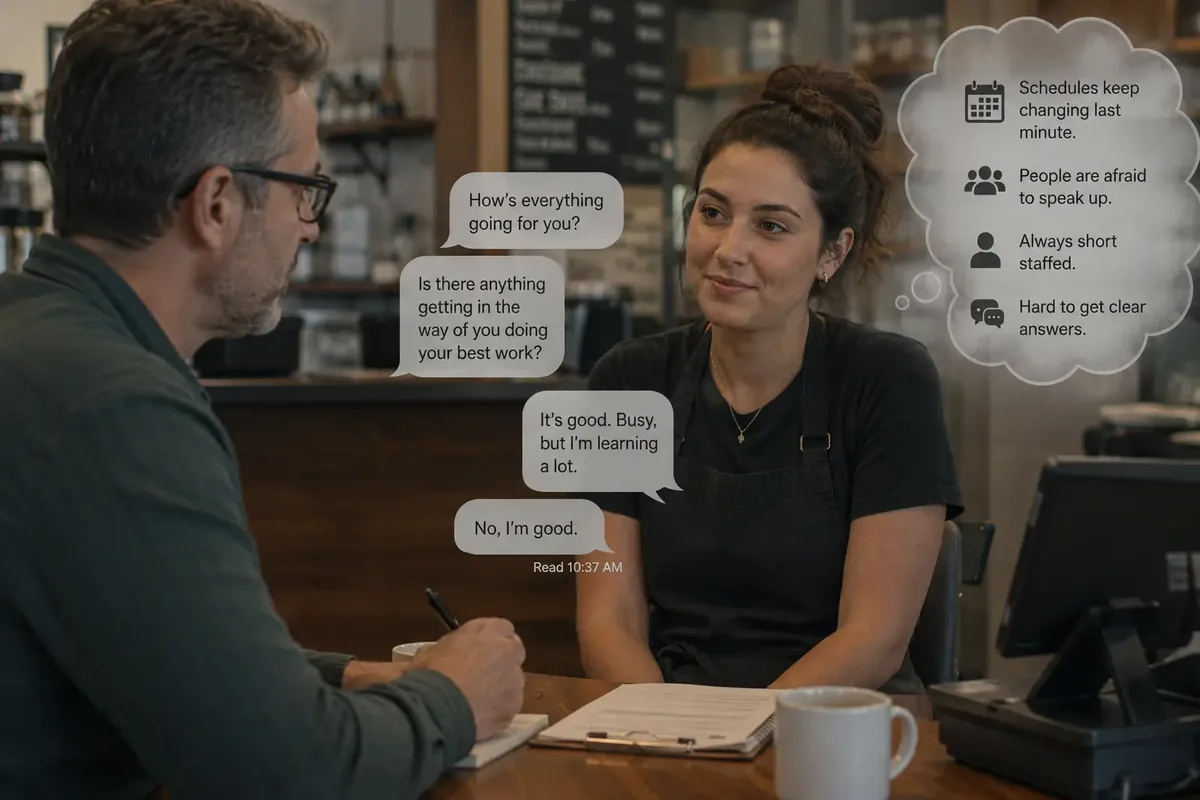
Fear of being "that employee"
Teams develop unwritten rules about who is negative, dramatic, or not a team player. One blunt comment in a face-to-face check-in can stick longer than a dozen helpful shifts. Detert and Edmondson describe implicit voice theories, taken-for-granted rules about when speaking up is safe. People default to silence when they expect blame or dismissal (Detert & Edmondson, 2011).
Many people become the employee who says things are fine, mentions only small fixes, or saves the real issue for someone they trust after work.
Protecting relationships and livelihood
Honesty has a cost when the listener controls schedules, shift quality, and future opportunities. Employees are not hiding truth because they are deceptive. They are managing risk:
- Reference and reputation: Small industries remember names.
- Day-to-day comfort: Awkwardness with a manager lasts every shift until someone leaves.
- Peer loyalty: Calling out a popular lead can feel like betraying coworkers.
- Past inaction: If earlier speak-ups failed, staying quiet is a rational choice.
Face-to-face asks put all of that on the table in a single conversation across a desk or counter.
Politeness is not the same as truth
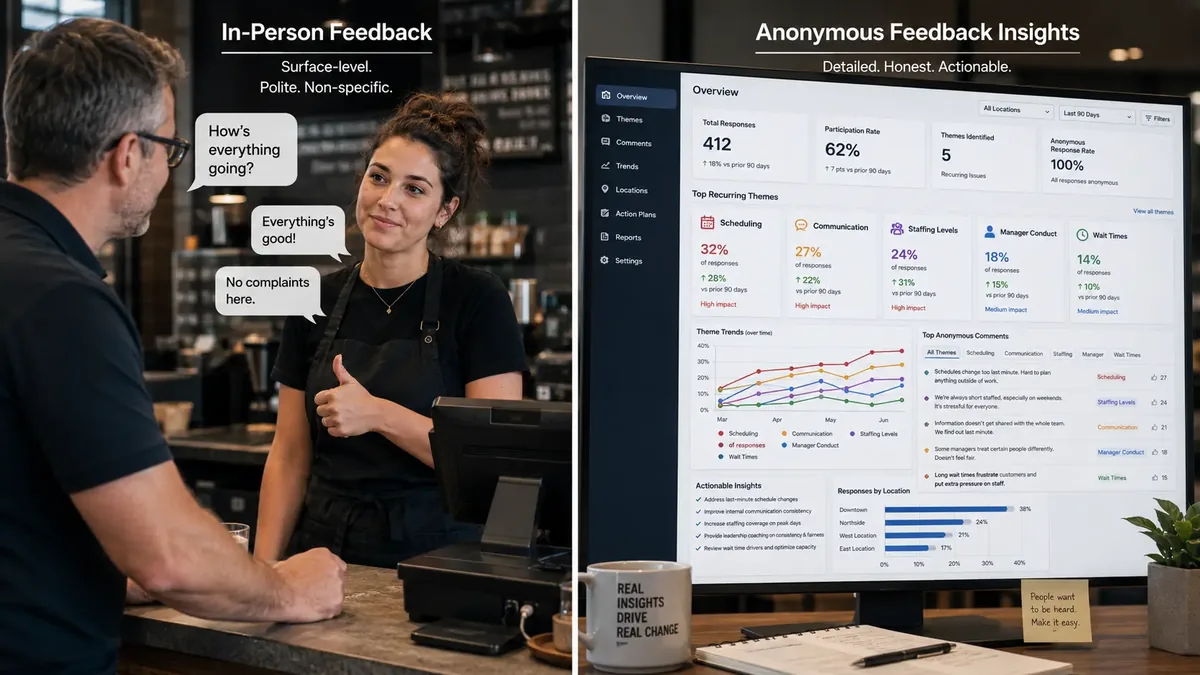
Politeness keeps relationships functioning: "All good on my end," "Just busy lately," "Communication could be better." Truth names what would change outcomes: favoritism on closes, a safety shortcut everyone uses, a manager who never follows up on promises.
Both can be sincere. Politeness is often the socially smart choice in the moment. Leaders mistake politeness for a clean bill of health and miss drift toward burnout and turnover.
Why anonymity can increase honesty (without replacing managers)
Anonymous feedback does not fix leadership by itself. It changes the audience: no single person in the room to disappoint, no immediate reaction to manage. Tourangeau and Smith show that people answer sensitive survey questions more candidly when the mode feels private and answers are harder to trace to an individual (Tourangeau & Smith, 1996).
Used well, private channels complement one-on-ones:
- Managers still build trust through behavior and follow-through.
- Employees flag operational themes without volunteering as the messenger.
- Leaders review aggregated patterns instead of pressing one uncomfortable meeting.
Edmondson's research on psychological safety in teams describes the long-term goal: a shared belief that speaking up is allowed (Edmondson, 1999). Anonymity can help while that belief is still developing.
How to ask for honesty without forcing it in the room
Practical habits for owners and managers:
- Separate relationship time from structured signal (private channel, short pulse, anonymous rollup).
- Ask for themes, not confessions: "What is slowing the team down?" works better than "Do you have a problem with me?"
- Act on patterns publicly; do not hunt for who wrote one line.
- Treat face-to-face time as listening and coaching, not the only audit of reality.
How MaskedReviews fits
MaskedReviews gives employees a neutral capture layer alongside normal conversations: short private submissions, no account required for respondents, and rollups that highlight recurring operational themes without exposing who wrote what. You hear what politeness filters out while you still manage in person.
References
- Bradburn, N., Sudman, S., & Wansink, B. (2004). Asking Questions (2nd ed.). Jossey-Bass. Open Library
- Detert, J. R., & Edmondson, A. C. (2011). Implicit voice theories: Taken-for-granted rules of self-censorship at work. Academy of Management Journal, 54(3), 461–488. doi.org/10.5465/amj.2011.61967925
- Tourangeau, R., & Smith, T. W. (1996). Asking sensitive questions: The impact of data collection mode, question format, and question context. Public Opinion Quarterly, 60(2), 275–304. doi.org/10.1086/297751
- Edmondson, A. (1999). Psychological safety and learning behavior in work teams. Administrative Science Quarterly, 44(2), 350–383. doi.org/10.2307/2666999
Join Early Founder ($5 for 90 days)
Complement one-on-ones with private employee capture so politeness is not the only signal leadership gets.
Early Founder: $5 for 90 days, then $10/mo locked for life. Standard pricing will be $19.99/mo.